|
|
Selecting the right instrument from the
hundreds available in music shops and on the internet can
be a daunting task! The following notes should help to
narrow the choice down and answer some of the most
commonly asked questions. I am more than happy to help new
and existing students select and acquire an instrument.
Please click
here to email me with your requirements. Please
remember to include a telephone number so I can call to
discuss options with you.
Saxophones
Flutes
Clarinets
Where to Buy
Having decided which instrument you want
to play, your budget will probably determine the make and
model you choose. Rather than list good and bad
instruments here I recommend a visit to the web sites of
the following specialist woodwind suppliers whose help and
advice I have valued highly for many years.
As a general rule of thumb, if these
shops don't stock an instrument I probably would not buy
it. Trusted and respected instrument repairers have
frequently warned me against buying many of the cheap
instruments that dominate internet auction sites and some
local second-hand outlets.
Nearly new or recently serviced second
hand instruments can make a good buy. The retailers below
have lists of second hand instruments on their web sites.
Be wary, however, when buying secondhand instruments
elsewhere. If the instrument needs a major service and
repadding it may cost £200 or more to overhaul.
For instrument repairs and servicing and
excellent advice I highly recommend
|
|
Steve
Lock (Instrument Repairs & Servicing) |
|
|
|
Utopia,
Manningtree Road
Stutton,
Ipswich
IP9 2SW
Tel: 01473 328038 |
|
Saxophones
For saxophonists, the first decision you
need to make is the size of saxophone. Unlike violins,
saxophones do not come in 1/4, 1/2, 3/4 sizes. They do,
however come in a variety of sizes, the most popular of
which are:
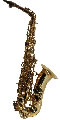 Alto Saxophone
The alto produces a bright clear sound and has been
used in jazz styles (e.g. Charlie Parker and Paul
Desmond) and modern styles (e.g. Dave Sanborn). The
alto is by far the most popular student instrument
and is best suited to children's small hands. It is
also more manageable for children to carry about.
Due to its popularity it is generally the least
expensive option. |
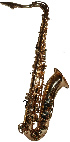 Tenor Saxophone
A little larger (and heavier) than the alto and
consequently less suitable for younger students
(i.e. under 12's). The tenor creates a darker,
richer sound which has been extensively used in
jazz and soul (e.g. Stan Getz, Coleman Hawkins and
Michael Brecker). Although a little more expensive
than the alto, the tenor can make an ideal student
instrument.
|
 Soprano Saxophone
No, it's not a metal clarinet! Since it is a smaller
instrument it doesn't need to be curly. (Curly
models are available but the cheaper instruments
tend to have more tuning problems). The soprano's
higher and generally sweeter sound has been
popularised by Kenny G. Although smaller than the
alto, the soprano is more demanding on the lip and
more expensive to buy. |
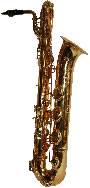 Baritone Saxophone
The baritone is a bit of a monster weighing in at
15kg in a case. It consequently suits those with
large biceps, budget and car boot space! Although
not often used as as student instrument (which is
a shame because it can sound fantastic!) the
fingering on all saxophones is almost identical.
It is therefore relatively easy to adapt to the
different saxophones having learnt to play on a
more manageable one. |
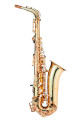 Alpha Sax
The Trevor James Alpha Sax (sometimes called a
kinder-sax) is essentially an alto saxophone with
some of the keys removed. It is lighter and the
removal of some key-work makes the instrument ideal
for younger students (from year 3) with small hands.
However, because the instrument cannot play the
highest and lowest notes it is only suitable up to
grade 3 level. It can therefore make an ideal
instrument to hire for young students. |
 J-Sax
This recent invention from Nuvo is a small, very
lightweight plastic instrument. It uses
saxophone-like fingerings (some of the fingerings
differ from a regular saxophone) and provides an
introduction to the saxophone for young students
before they progress on to a saxophone.
|
Where to buy
Saxophones
Flutes
For all beginner flute students I
recommend:
- a standard concert flute (i.e. not
a piccolo, alto or bass flute or a keyless flute.
Although it is possible to learn on a piccolo, alto or
bass flute, these instruments can be more demanding and
expensive for a beginner.)
- with closed holes (open hole
flutes suit professional players but are less forgiving
for students)
- with offset G (most students
flutes have this)
- with split E mechanism (most
modern students flutes have this)

Where to buy
Flutes
Clarinets
 I recommend a
standard Bb clarinet for most beginner students. The
modern plastic student instruments (e.g. Buffet B12) have
a good tone, are easy to look after and are lighter than
the traditional wooden instruments.
Clarinets in Eb and A and bass clarinets
are more specialist instruments.
The Lyons C clarinet is a recent
invention. Its lighter and simpler construction can make
it an easier instrument for younger students. However,
students will inevitably need to transfer to a Bb
instrument and school bands rarely have appropriate parts
written out for the C clarinet. As a consequence it is
rarely seen.
Where
to buy Clarinets
|